




Create, test, and manage AI assets in one local-first workspace.
So you can keep the source and its dependencies visible before anything ships.
Explore Hub →Viorant is building AI Deployment Infrastructure: a neutral boundary between the AI system you define and the environments where it runs. Meaningful AI objects keep their own identity; .vio composes them into the complete system definition.
Meaningful AI objects keep distinct identity; .vio composes them into the complete system definition.
The model lives in one dashboard, prompts in a repository, memory in another service, policies in documents, and deployment logic in provider-specific pipelines. The running system is assembled from state no single artifact records.
Every hand-off makes you answer the same questions again:
Fragmentation compounds across the lifecycle:
Another framework does not
solve fragmentation.
AI needs a portable definition
independent of the runtime.
The asset should outlive the editor, model provider, framework, cloud, and hardware chosen to execute it.
Viorant keeps definition, provenance, transformation, deployment, and governance connected without sitting in the inference path.
So you can keep the source and its dependencies visible before anything ships.
Explore Hub →So you can review and move models, prompts, agents, skills, memory, connectors, and policies without hiding their relationships.
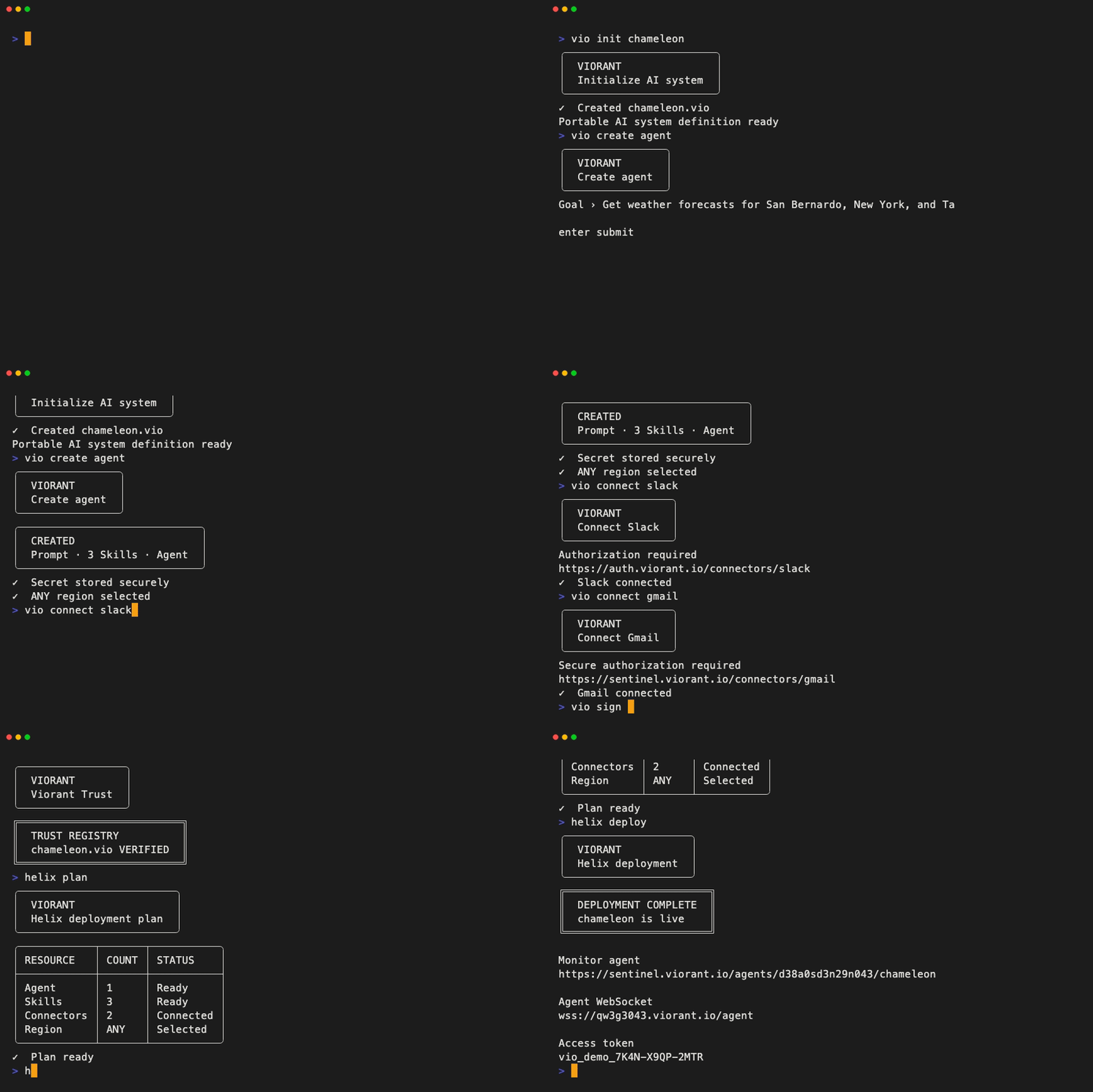
Explore .vio →So you can prove origin, integrity, version, and approval before deployment.
Explore Trust →So you can change the destination without redefining the asset around each provider.
Explore Helix →So you can run through Viorant infrastructure without making it the permanent home of the asset.
So you can carry governance into operation instead of adding it after deployment.
Hub establishes the local source. Each later product adds portability, trust, deployment, or governance around the same .vio artifacts.
Author, test, preview. Local-first, free.
One portable artifact.
Prepare supported deployments.
Managed runtime.
Prove origin, version, approval.
Observe, audit, catch drift early.
Prompt and context compression.
The artifact remains yours as the surrounding platform expands.
Declare model requirements explicitly and use providers supported by the current product and documentation.
Declare connector requirements explicitly and use the current supported integrations and MCP interfaces.
The systems we are building do not think. They produce outputs that resemble thinking, often more useful than thinking, yet the mechanism is statistical, not human. The distance between what a model produces and what we can verify it understands is the epistemic gap, and it widens by the day.
The response to a gap one cannot close is not faith. It is structure: signed artifacts, declared agents, versioned policy, sovereignty by default. We govern what we cannot fully comprehend. We have always done so with people. We must now do so with their instruments.
That is the work. To civilize intelligence.
Viorant does not replace Git, your frameworks, models, or cloud. Hub is local-first, you bring your own keys, and .vio keeps the source portable. Your deployed runtime calls its models and tools directly. Viorant does not become a tollbooth.

Civilize intelligence.
Start locally with Viorant Hub, with 2,500 free credits included.